



The Evolution of Social Networking: From Forums to Metaverses
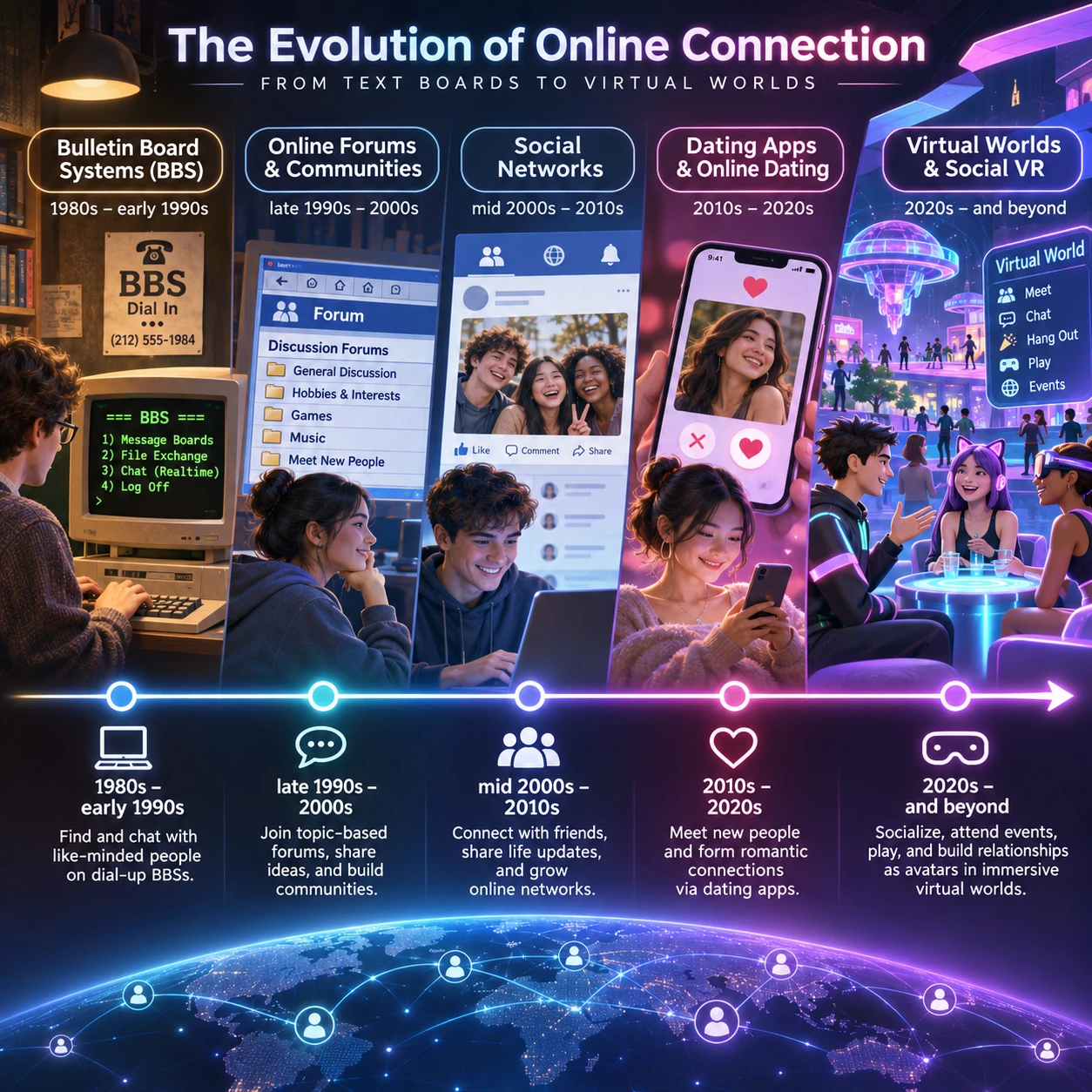
Social networking has changed how people meet, share interests, and build relationships. The journey runs from bulletin board systems and online forums to chat rooms, social networking sites, mobile social apps, and immersive metaverse spaces. Each format has offered a different way to belong, including a place to find potential partners, but none has replaced the human need for trust, conversation, and shared experience.
Early online communities: forums and bulletin board systems
Online forums and bulletin board systems (BBS) helped people form communities around shared interests, even when members were far apart. They made online connection possible through persistent conversations rather than face-to-face meetings.
Before modern social media, people often used a BBS by connecting to a host computer over a telephone line. They could post messages, read replies, share files, and join discussions on topics such as hobbies, technology, or local events. Online forums later made this kind of exchange easier to access, organizing conversations into topic-based boards and threads.
The slower pace had a social advantage: people could think before replying, and useful posts remained available for others to find. Over time, familiar usernames and recurring conversations created a sense of recognition. A forum could become a genuine virtual community, even if members never knew one another’s offline names.
That structure also had limits. A new member had to learn the local norms, and conversations could take hours or days to develop. For dating, forums sometimes offered a natural way to meet through a shared interest, but they were not designed for matchmaking. Connection began with participation, not a profile promising compatibility.
Chat rooms and social networking sites bring connection into real time
Chat rooms and social networking sites made online interaction more immediate and personal. Live conversation brought the feeling of being together, while profiles and friend networks helped people find and maintain connections.
In chat rooms, participants could exchange messages in real time, often under screen names. Topic-based rooms made it easy to join a conversation about music, games, or relationships. The speed created spontaneity, though it also meant conversations could move quickly and disappear. Users had fewer ways to verify who was behind a username, so trust depended heavily on what people chose to share.
Social networking sites changed the format again by centering profiles and visible connections. A profile could include a name, photograph, interests, and updates; a network of friends made it easier to reconnect and discover people through mutual contacts. Compared with forums, the emphasis shifted from a shared topic to an individual’s social identity and relationships.
These tools made it easier to maintain ties across distance, but also introduced new privacy questions. Public posts can reach beyond their intended audience, and a profile gives only a partial view of someone’s life. In dating and friendship alike, online familiarity should not be mistaken for verified identity or real-world trust.
Dating moves from niche websites to mobile apps
Online dating platforms evolved from dedicated websites into mobile social apps that let people discover and message potential partners wherever they are. This made dating more accessible, while changing the pace and volume of introductions.
Early dating sites typically asked users to create a profile and browse or search for people who matched selected preferences. The process was deliberate: people filled out information, read profiles, and initiated contact through the website. For some, this offered a welcome alternative to meeting through friends or at local venues. For others, writing a profile and waiting for a reply felt formal or exposed.
Smartphones changed the experience. Mobile social apps combined profiles, photos, messaging, and location-aware discovery in one portable interface. A person could check messages during a commute or arrange a date without being tied to a computer. Matching and browsing also became more continuous, which can help users meet beyond their immediate social circles.
Convenience has a trade-off. A quick profile can make first impressions depend heavily on photographs and brief prompts, while an abundance of choices may make each conversation feel disposable. A practical approach is to use the app to start a conversation, then look for signs of mutual interest and respectful communication. Keep personal details private until trust develops, and arrange first in-person meetings in public places.
Social networks become everyday community spaces
Modern social networks support more than dating: groups, feeds, and messaging let people maintain friendships and join communities around shared interests. For many users, social life online now moves between public posts, private conversations, and organized groups.
A local group can help someone find a walking partner or a neighborhood event. A hobby community can turn occasional comments into lasting friendships. Feeds make it easy to keep up with people, while direct messages give members a private channel to continue a conversation. These formats can overlap with online dating: a relationship may start in a shared community, or an existing social network may help people learn about one another before meeting.
The mix matters. Groups can provide context and a shared purpose, which may make introductions feel more natural than a cold message. At the same time, large networks can create noise, and algorithmic feeds may prioritize attention-grabbing posts over quiet, supportive interaction. Community guidelines, active moderation, and clear boundaries help make shared spaces more welcoming.
Consider what you want from a platform before joining. If you are looking for friendship, a well-moderated interest group may serve you better than a broad feed. If you want to date, a dedicated dating platform may make intentions clearer. Some people prefer to keep these parts of life separate; others enjoy the overlap.
The metaverse adds presence and immersion
The metaverse describes networked virtual environments where people interact through avatars, shared spaces, and, in some cases, virtual reality (VR). These experiences can make socializing feel more spatial and interactive than a profile page or text chat, but access and adoption vary.
In a virtual environment, people might attend a concert, explore a game world, or gather in a room as avatars. Voice, movement, and shared activities can give a conversation more cues than text alone. For dating and community, that could mean meeting through a group activity before deciding whether to continue the conversation privately or offline.
Still, immersion is not the same as intimacy. An avatar may encourage self-expression, but it can also make identity harder to verify. VR equipment can be expensive or uncomfortable, and some users prefer a phone or computer screen. Moderation also becomes more complex when people interact through voice, gestures, and virtual space. Platforms need clear reporting tools and practical ways to address harassment and unwanted contact.
Metaverse spaces are best understood as another option in the social toolkit, not a guaranteed replacement for existing networks. They may suit people who enjoy games or embodied interaction; text-first forums and mobile apps remain more accessible for many others.
What the evolution means for connection today
The evolution of social networking shows that each new format changes how people meet, but lasting connection still depends on shared interests, trust, and attention. Forums prioritize topic and thoughtful exchange; chat rooms offer immediacy; social networks make relationships visible; dating apps focus discovery; and metaverse spaces add a sense of presence.
A useful way to choose among them is to ask three questions: What kind of connection do I want? How much personal information am I comfortable sharing? What communication style feels natural to me? A person seeking advice may prefer a moderated forum. Someone hoping to meet a partner may choose an online dating platform. People who want to socialize through shared activities might explore a virtual community, with or without VR.
Each option brings trade-offs. More visibility can help people discover one another, but it can reduce privacy. Faster messaging can make introductions easier, but it may leave less time to assess compatibility. Immersive interaction can add context, yet it depends on access, design, and moderation. No single platform works equally well for every person or purpose.
The next phase of social networking will likely keep blending formats: profiles linked to groups, messaging alongside live events, and virtual spaces connected to familiar social apps. The useful question is not whether one technology will replace all the others. It is whether a space gives people a safe, comfortable way to meet and build the kind of connection they actually want.